


Nestled beneath San Francisco’s elevated freeways where Highway 101 converges with the Mission District, a hidden artistic sanctuary awaits discovery. Climbing three flights of weathered red metal stairs leads visitors to the Lost Art Salon, where co-founders Rob Delamater and Gaetan Caron have cultivated something extraordinary: a gallery celebrating 20th-century artists whose work nearly vanished from cultural memory.
Unlike traditional white-walled galleries, this intimate space resembles a welcoming home, complete with a crackling fireplace and comfortable seating arrangements. “People are willing to make that extra journey because they’re seeking an authentic experience,” explains Delamater, who recognized early on that conventional gallery environments don’t reflect how most people actually live with art.
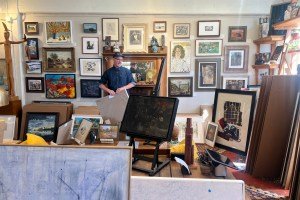
[Image: The framing shop at Lost Art Salon. Photo by Julie Zigoris]
The salon’s approach transforms art purchasing into something more meaningful. Visitors browse framed pieces displayed throughout the living-room-style space, while complete collections stored in upstairs rooms and back chambers offer deeper exploration opportunities. Every artwork comes with its own compelling backstory,whether it’s a closeted queer artist whose partner preserved his legacy decades after his death, or a former Gulag prisoner who later worked for the CIA in Washington D.C.
During the pandemic lockdown, when physical visits became impossible, Delamater intensified his social media storytelling efforts. This digital pivot proved transformative, becoming the primary way most people discover the business today, supplemented by word-of-mouth recommendations and loyal repeat customers. Even after 22 years of operation, many within the art community remain unaware of this remarkable establishment.
The venture’s origins trace back over two decades when Delamater, then working in hotel design, struggled to source affordable original artwork for commercial projects. “I couldn’t even figure out where to buy art for my own apartment,” he recalls. During conversations with Caron about this challenge, they conceived an ambitious idea: What happens to the artistic legacies of lesser-known but talented creators?
Their first acquisition,a work by Clyde F. Seavey, a commercial illustrator who contributed to publications like The American Weekly,launched their inaugural exhibition at a flower shop on 16th Street. Subsequent shows at fine furnishing stores and pop-up locations across the city gradually built momentum. As they discovered the extensive catalogs of forgotten artists like Seavey, Delamater and Caron evolved from collecting individual pieces to acquiring entire artistic estates.
“We realized our true mission wasn’t just representing lost artwork, but resurrecting lost artists themselves,” Delamater reflects. This philosophy became their guiding principle for acquisitions: any collection must contain work that resonates with contemporary audiences and complements modern living spaces. Today, they purchase complete catalogs ranging from 75 to 500 pieces annually.
Their curation remains highly selective,evaluating approximately 15 collections yearly from hundreds presented, focusing exclusively on established artists whose works appear in museum collections and published catalogs. Many achieved professional recognition but never reached “blue-chip” status, causing their contributions to fade from art history narratives.
Caron brought corporate experience from the early internet era to complement Delamater’s background in creative fields. Both are practicing artists who initially collaborated on personal projects before recognizing they’d essentially created their own gallery space. Their own artworks now hang alongside the rediscovered masters in the main showroom.
[Image: Lost Art Salon co-owner Rob Delamater. Photo by Julie Zigoris]
Business growth necessitated expansion, leading them to occupy previously rented upper-level spaces. With an adjacent tenant preparing to vacate, they’ll soon control the entire third floor,four interconnected rooms providing ample display area. While space constraints might eventually pose challenges, the supply of undiscovered artistic treasures shows no signs of diminishing.
“This feels like watching the ocean continuously deliver new seashells to shore,” Delamater observes. “The discoveries never cease.”
A recent trip to New York crystallized their impact when visiting a collection originally housed at the former American Gallery on Manhattan’s Upper East Side. Stored since the 1970s by a widow who closed her gallery following her husband’s untimely death, these works mirrored Delamater and Caron’s own journey as artist-entrepreneurs. “Reviving their legacy will become one of next year’s featured exhibitions,” Delamater announces with evident enthusiasm.
The team has grown to include seven employees, supporting operations that extend far beyond local boundaries. Online sales reach customers nationwide, with several pieces selling weekly across the country. Self-portraits of featured artists adorn the framing area walls, serving as daily reminders of the human stories behind each piece.
“These aren’t just objects,they’re real stories,” Delamater emphasizes. “Every artist has become my teacher in some way.” He dedicates specific days to his own creative practice, often experimenting with techniques inspired by the masters surrounding him, treating these rediscovered talents as his informal university.
In revitalizing forgotten artistic voices, Delamater sees participation in a broader 21st-century cultural mission: expanding the art historical canon. “I genuinely feel the presence of all these artists when I’m alone in the space,” he shares. “It’s as if they’re all communing together.”
Once a devoted follower of Evangelical Christianity,where he met Caron in 1987 during a year-long study program,Delamater has since embraced different spiritual pursuits. Today, he seeks purpose through spreading meaning one art-filled room at a time, transforming both lives and living spaces through carefully curated creative legacies.