


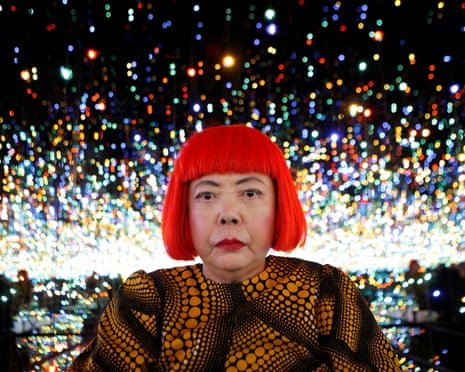
Yayoi Kusama, the Japanese outsider artist who became a global superstar after decades living in a psychiatric hospital, has died at the age of 97. She passed away in a Tokyo hospital on 14 August. Her death was announced by her studio through a statement on her official website. Throughout her extraordinary life, Kusama devoted herself entirely to artistic creation, pursuing an internationally acclaimed career as a pioneering avant-garde artist whose practice spanned visual art, performance, fiction, and poetry.
She continued painting until her final days, never abandoning her brush, and explored themes of eternal love and the soul. Kusama’s studio expressed her wishes to continue bringing hope and strength through art to people worldwide. Recognizable by her bright red bobbed wig, Kusama became famous for her psychedelic color schemes and mirrored installations, which gained a massive following in the age of social media selfies.
Initially, she pioneered themes like infinity and self-obliteration in the 1960s, though she faced temporary obscurity. Kusama was born in Matsumoto, Japan, in 1929, enduring a difficult childhood due to an abusive mother and a philandering father. Despite her mother’s attempts to stop her, Kusama drew flowers as a child, which later inspired her art. During World War II, she was conscripted to produce fabric for Japanese army parachutes.
After studying traditional Japanese painting, she left Japan for New York in 1958, where she collaborated with artists like Donald Judd and developed her signature infinity net paintings. In 1962, she sold her first such painting for $75. Her work, including soft sculptures and performance pieces, often addressed themes of sexuality and self-identity. Despite initial rejection by the art world, Kusama gained recognition later in life, with retrospectives at major museums like the Museum of Modern Art, Tate Modern, and Hirshhorn Museum.
Her installations, such as the Infinity Mirrored Room, became global phenomena, though she always preferred to be seen as an outsider. Kusama’s legacy includes her controversial yet politically charged performances, such as staging a homosexual wedding in New York and protesting the Soviet invasion of Czechoslovakia. She also faced mental health struggles, including hospitalizations, but found stability in Tokyo’s psychiatric hospital, where she lived and worked until her death.