

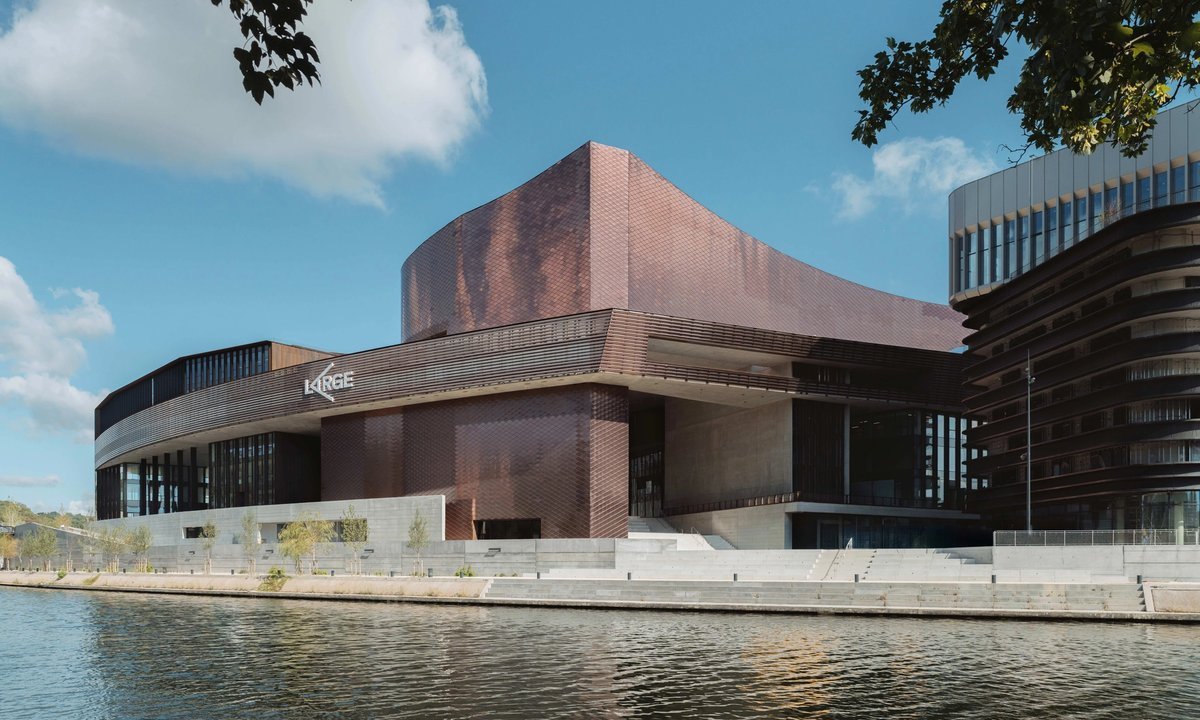
The French capital’s latest contemporary art venue opens this Saturday, 17 October, on the Ile Séguin in western Greater Paris. Known simply as Large (or “le Large”), this project marks the latest philanthropic contribution from the Emerige real estate group and forms the heart of the broader Pointe des Arts development. Unlike private museums such as those operated by the Cartier and Louis Vuitton foundations, Large functions as a non-profit institution with no fixed collection, prioritizing public accessibility and the promotion of France’s living art scene.
The Pointe des Arts complex was conceived by the Spanish architecture studio RCR Arquitectes in partnership with the Paris-based design agency CALQ. The three interconnected buildings employ a striking material palette: weathered Corten steel that embraces deliberate rust, copper-hued aluminum cladding, and glass panels. Together, they house an eight-screen cinema, retail spaces, office areas, and the Large gallery. Situated at the development’s core, Large rises as a six-story wedge of exhibition space spanning approximately 2,500 square metres.
Director Paula Aisemberg emphasizes that art greets visitors immediately upon arrival. The opening exhibition, titled Imaginary Engine, draws inspiration from the island’s automotive heritage, reflecting the period when Renault maintained its primary manufacturing plant there throughout much of the 20th century. Curated by Cecilia Alemani, the show juxtaposes works from Renault’s own Fonds Renault pour l’Art et la Culture with seventeen newly commissioned pieces from contemporary artists.
An exhibition view captures the immersive experience. In the foreground, Romuald Jandolo presents Estafard (2026); in the background, Julio Le Parc contributes Peintures en frise (1971-74). Photographer Aurélien Mole documents these installations. Since the millennium, Emerige Group founder Laurent Dumas has actively sought to deepen ties with the national art world through commission programs, acquisitions for his private collection, and the Révélations Emerige prize established in 2014 for emerging, unrepresented artists under 35.
Aisemberg stresses that Large’s commitment to showcasing artists currently working and living across the nation,regardless of nationality,is what distinguishes it from other institutions. She declares: “The French art scene is particularly riveting. We aim to support it, promote it, and make it accessible to the wider public, whether it is the international community unfamiliar with our work or the local public lacking easy access.”
Geographically, the île Séguin lies between the Porte de Saint-Cloud and the Pont de Sèvres, at the junction where the Seine leaves central Paris heading southwest before looping toward the Bois de Boulogne and Saint-Denis.
The island’s transformation began after Renault closed its factory on the site from 1919 to 1992. Over the decades, efforts to convert the former industrial land into a cultural destination faced numerous obstacles. François Pinault’s museum ambitions stalled due to bureaucratic hurdles, while the ambitious R4 art city project,originally envisioned by architect Jean Nouvel,was abandoned when its backer, Swiss dealer Yves Bouvier, withdrew.
Emerige founder Laurent Dumas describes the île Séguin project differently: “As a developer, the île Séguin was ‘a dream becoming reality’ and one of my most beautiful challenges.” His vision aligns with the broader Vallée de la Culture initiative launched by the Hauts-de-Seine department in 2008, which treats the island as the jewel in a larger cultural crown. The Pointe des Arts development complements a constellation of nearby institutions, including Jean Dubuffet’s Tour aux Figures on the Île Saint-Germain, the Cité de la Céramique in Sèvres, the Manufacture Nationale, the Musée des Années 30, the Albert Kahn Museum and Gardens, and the Musée Belmondo in Boulogne-Billancourt.
This momentum continues with upcoming plans for the Musée du Grand Siècle at the Caserne Sully in Saint-Cloud, fitting within Saint-Cloud’s larger cultural strategy as part of the wider Grand Paris plan for 2050. That strategy pairs urban renewal with major transportation investments to render suburban Paris more connected and attractive, alleviating congestion across multiple dimensions. One anticipated landmark is a new Grand Paris Express metro station at Pont de Sèvres, set to open in 2027, placing the island only minutes from La Défense and roughly thirty minutes from Orly Airport.
The island also resonates thematically with Large’s identity, echoing modernist ideals of speed and mechanical elegance that permeate its inaugural exhibition.