
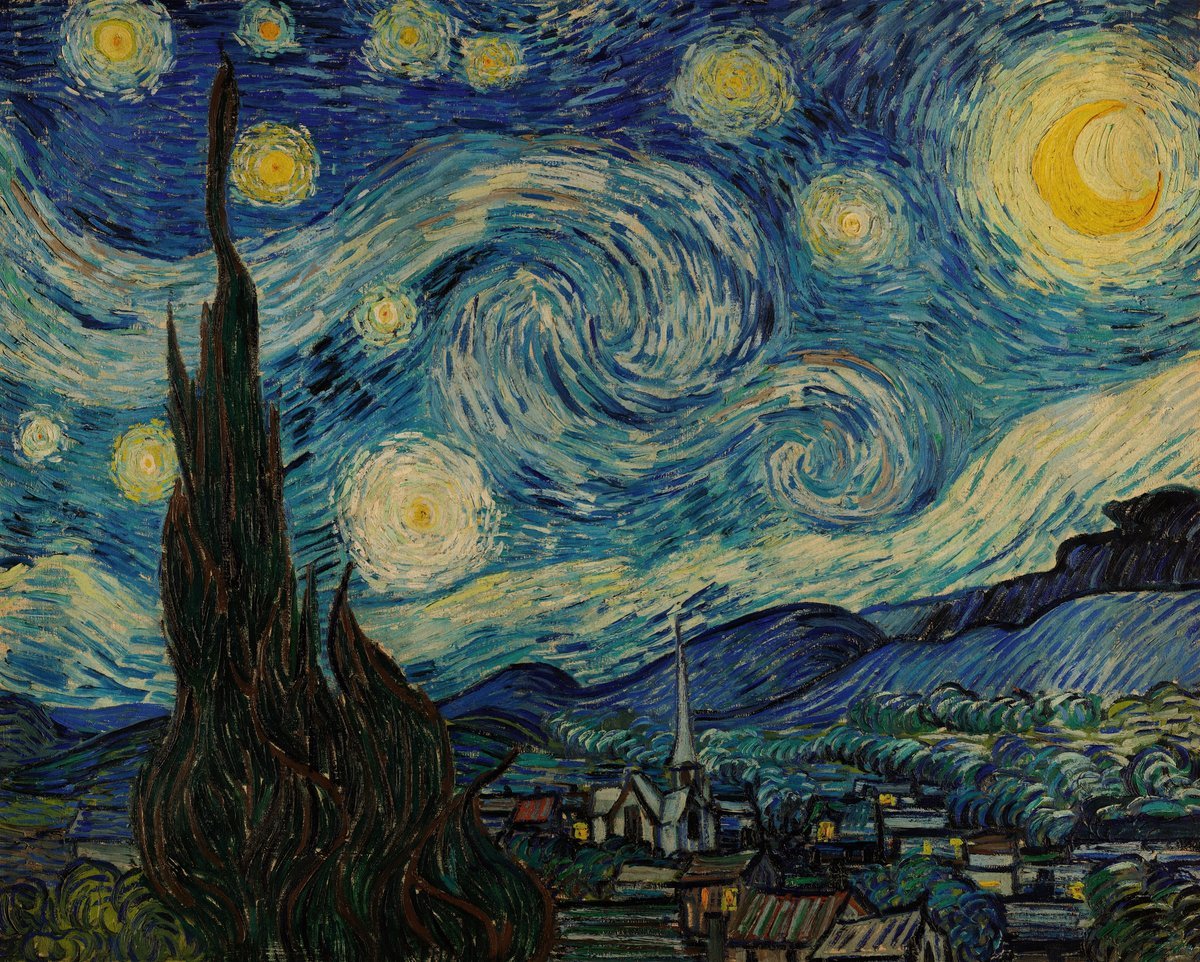
For decades, art historians and astronomers have debated the celestial inspiration behind Vincent van Gogh’s iconic 1889 painting, The Starry Night. Now, a new study suggests the masterpiece’s swirling sky depicts a specific star cluster that could shift the timeline of its creation. Researchers have identified the constellation in the painting as the V-shaped Hyades cluster within Taurus, rather than the previously assumed Aries, pointing to a late July 1889 date for the work.
Published on October 22 in the journal Scientific Reports, the analysis relies on a software tool called Procrustes. This program matches the geometric shape formed by the relative positions of stars, filtering out artistic liberties like size or color. By focusing purely on spatial patterns, the researchers matched five stars in The Starry Night to five stars in the Hyades cluster, yielding the strongest statistical fit among all constellations tested. “To my eyes, the star cluster in The Starry Night was the Hyades in Taurus,” says lead author Elijah Jeong-hyun Kim, a space researcher. “At that moment, I was sure this painting was worth studying.”
To validate their method, the team applied Procrustes to Van Gogh’s Starry Night over the Rhône, which features the Big Dipper, and Café Terrace at Night, which depicts the Summer Triangle. In both cases, the software successfully identified the correct constellations with a statistical strength comparable to the match found for The Starry Night.
The shift from Aries to the Hyades has significant historical implications. Van Gogh famously wrote of “a new study of the starry sky” in a letter dated June 18, 1889, leading historians to place the painting in mid-June. However, the researchers argue that the letter does not mean the work was finished. Several lines of evidence support a late July date. For instance, the moon in the painting is a waning crescent, which aligns with late July. In mid-June, the moon would have been in a waning gibbous phase, appearing as a lopsided oval. Furthermore, the stars of Aries are relatively faint, “hardly enough to inspire a painter” at dawn, when Van Gogh often observed the sky, Kim notes.
Kim also traveled to Saint-Rémy-de-Provence in 2019 to reconstruct the exact field of view from the window of the Saint-Paul-de-Mausole asylum, where Van Gogh was staying. The physical vantage point further confirmed the visibility of the Hyades cluster during that period. “If the identification holds, we can look up today and recognize the same stars Van Gogh saw,” says James Beattie, a Hubble fellow at NASA.
Not everyone is convinced. Don Olson, a physics and astronomy professor emeritus at Texas State University and self-proclaimed “celestial sleuth,” argues that the position of the brilliant planet Venus in the painting does not align with the calculated position of the Hyades cluster. Olson maintains that the researchers’ conclusions “require strong evidence to overcome Vincent van Gogh’s plain statement” from June 18.
Kim acknowledges the ongoing debate but argues the burden of proof has now shifted. “The Starry Night spoke to an astronomer like me,” Kim says. “I listened to its voice.” While mysteries remain, the study offers a compelling new chapter in the ongoing dialogue between art and science.