


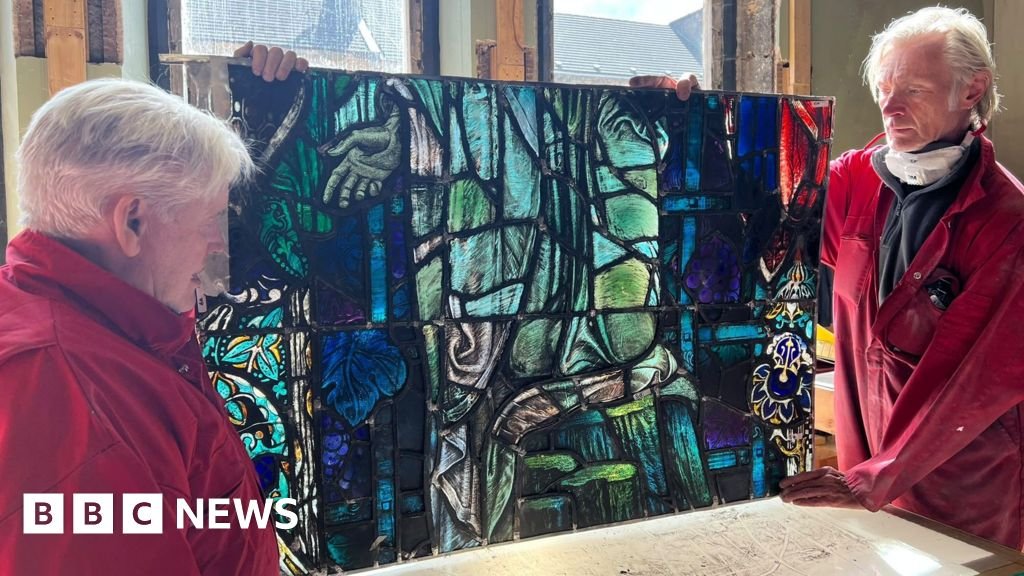
A small conservation team is readying the historic glass for the upcoming museum opening in Glasgow.
Long before the city earned its reputation as a workshop of the world, Scotland was celebrated for its arts and crafts, with stained‑glass production at the heart of that legacy. Much of the glass travelled far afield – James Guthrie’s Thistle window, for example, can still be admired in Budapest’s Museum of Decorative Arts. Other pieces were crafted for ocean liners, surviving only in photographs of those grand voyages, while hundreds remained in Scotland, adorning churches, private homes, civic buildings and community spaces.
Among the surviving works are two notable windows by Alf Webster, whose designs often blend religious iconography with natural symbols. The Templeton Window presents eight scenes from the life of Christ, and the McCowan Window depicts Holy Week in three large panels. Both were created in the early twentieth century and offer more than devotional imagery; they reveal details about the era, the craftspeople who made them and the patrons who commissioned them.
Dr Karen Mailley, a researcher involved with the project, explains that Webster’s windows were intended to be “read” from top to bottom, a practice that has largely disappeared today. She hopes the new museum will help visitors understand the narratives embedded in the glass.
The Alf Webster Museum of Stained Glass is set to open in the former Lansdowne Church early next year. The heritage charity behind the initiative has been working on the project since 2013, when the last congregation departed. Trustee David Robertson notes that the charity’s role was to ensure the building’s survival and to establish an income stream for its future use.
Although the Webster windows – composed of numerous panels – will form the centrepiece of Scotland’s first dedicated stained‑glass museum, modern technology allows individual panels to be removed, examined, repaired and replaced without disturbing the whole assembly. This flexibility makes it possible to rotate works from various collections, including Glasgow Museums, giving repeat visitors something new to see each time.
Alf Webster was born on Glasgow’s south side in 1883. He studied at the Glasgow School of Art before apprenticing at the prestigious Adam Studio. After the death of founder Stephen Adam Senior in 1910, Webster took over the studio and began to express his own design voice. Over the next few years he produced as many as forty windows across Scotland, including those now housed in Lansdowne Church. The McCowan Window was installed in 1914, marking the close of his brief but prolific career. A year later, while serving with the Gordon Highlanders at Ypres, he sustained serious injuries and died shortly thereafter at the age of thirty‑one.
Robertson reflects that Webster’s talent was cut short prematurely, and because churches are not regularly open to the public, few have had the chance to see his work. The museum aims to finally showcase his contribution to stained‑glass art.
While the Templeton Window remains in its original location, the McCowan Window was removed in 2007 and stored until restoration plans progressed. Funding from the National Heritage Lottery Fund, Glasgow City Heritage Trust, the Architectural Heritage Fund and a public crowdfunding campaign has made the conservation work possible.
Scotland possesses a rich stained‑glass heritage, yet opportunities to display it publicly are limited. The new museum intends to construct a viewing platform that will give visitors a rare close‑up look at the panels. Mailley emphasizes the urgency of the moment, noting that around eight hundred churches are being sold off, representing a substantial amount of historic glass. A dedicated centre can both promote traditional techniques and elevate stained glass as an art form.
Preparation of exhibits continues apace. A century ago the neighbourhood surrounding Lansdowne Church hosted numerous glass studios. Today the effort falls to a small conservation team – Rab MacInnes, Eilidh MacKenzie and Gordon Muir – who are training apprentices and volunteers to care for existing works and to create new pieces.
One recent contribution, a window by Rab MacInnes, bridges the two distinct sections of the former church. Installed in the Kelvin Bar, where patrons of the Stand Comedy Club gather before performances, it offers a glimpse of what visitors might encounter upstairs in the museum.
Robertson adds that the project is only the first phase. He appreciates the juxtaposition of a comedy venue below and a culturally traditional display above, all within the same building, and hopes the public will share that sense of harmony.