


I n the early 1970s, the Korean artist Ha Chong-Hyun had a simple but novel idea: why not apply oil paint to the back of a surface rather than the front? Instead of canvas, he stretched pieces of hemp, a coarse and loosely woven fabric, and pushed the thick oil paint through the holes in the cloth. For each work, he used a single color, in a neutral or muted tone such as white or brown. On the front side, he moved the paint around with various handmade tools to create something akin to brushstrokes. Ha, now 91, has remained dedicated to this technique, known as the “back-pressure method” (bae-ap-bub in Korean), ever since. He titles every piece Conjunction—because for him, the work is essentially about the coming together of artist and material—along with numbers denoting the date of its creation.
Max Bossier, director at Lisson Gallery in London, notes that Ha’s technique was revolutionary. It hadn’t been done before. Today, Ha is recognized as one of the foremost Korean painters of his generation, part of an influential group of artists from the 1970s known for their spare simplicity of color and material. The movement was later named Dansaekhwa, meaning ‘monochrome painting.’ By the 2000s, Ha’s work and that of his peers like Lee Ufan and Park Seo-Bo began gaining international recognition, accelerating in the past decade. The Lisson Gallery exhibition in September showcases decades of Ha’s work alongside earlier experiments, with a North American museum retrospective opening soon in San Francisco.
At first glance, Ha’s abstract paintings may seem similar to other non-representational artworks from the 20th century, such as those by US minimalist Robert Ryman. However, his approach carries deep cultural specificity. Born in Sancheong, Korea, in 1935, Ha lived in Japan during its occupation before returning after liberation in 1945. His early experiences, including losing his grandmother and sibling during a storm at sea, shaped his artistic journey. He began drawing young, creating a portrait of Yi Jun, a Korean independence activist, which his teacher displayed in the classroom.
In the turbulent decades following liberation, Ha developed an artistic language that reflected historical circumstances. Abstraction, for him, was partly a rebellion against the state’s preference for figurative art. The use of hemp as a support for his paintings stemmed from necessity during the Korean War’s aftermath, when conventional art supplies were scarce. Ha explains that he repurposed coarse sacks carrying grain and relief supplies. His technique of working back-to-front has never been about repetition but about continually exploring new possibilities within his artistic language.
Over time, Ha introduced variations to his practice: using a flame to singe the paint, switching to wooden slats as support, and incorporating brighter colors like red and blue. He emphasizes that a painter should never let their palette dry, and he continues working as long as his health allows. His works, such as *Conjunction 93-002* (1993) and *Conjunction 20-118* (2020), exemplify this evolution. Bossier highlights the meditative quality of Ha’s method, which involves repetitive physical manipulation of paint with tools like palette knives and sticks.
Ha’s early works often included industrial materials like barbed wire or metal springs, connected to the three-dimensional quality of his *Conjunction* paintings. His reflections on his practice reveal a commitment to reinterpreting reality: ‘Painters normally apply paint to the front of a canvas; I began to ask myself, almost instinctively, what might happen if I approached it from the other side.’ His recent works have expanded color use, particularly reds and blues, while maintaining the continuity of his artistic language.
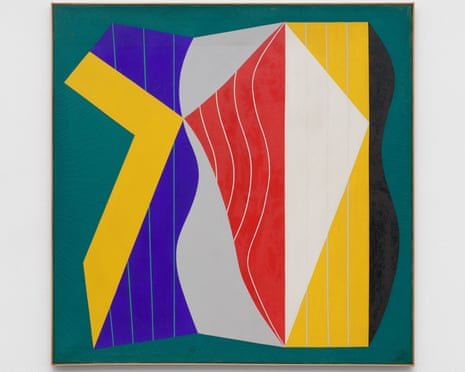
The exhibition at Lisson Gallery, running from 24 September to 7 November, features works like *White Paper on Urban Planning No 5* (1968), reflecting Ha’s response to Seoul’s rapid urban transformation post-war. Ha describes how he sought to capture the city’s emerging geometric and architectural energy in his art. His dedication to experimentation and innovation continues to define his artistic legacy.